The platform
One operational spine.
Phibian is one operating platform, not a suite. Capability families share a single model of your organization — the same people, assignments, permissions, evidence and audit trail — so operational context survives the boundaries between them.
What the platform is
Built as a foundation, then capabilities on top of it.
Most operational software becomes a collection of features that each learned the organization separately. Phibian was built the other way around: the shared foundation first, so that every capability inherits it.
One tenant model
Every record belongs to an organization, and the boundary is enforced in the database rather than remembered in application code. Multi-organization membership is a first-class concept, not a workaround.
One permission model
Roles and permissions are shared by every capability, scopeable down to a program or a location. Adding a capability does not add a new way to get access wrong.
One record of what happened
Time, location, exceptions, corrections and approvals reference the same operational events. Corrections supersede; originals persist.
One audit spine
Consequential actions and sensitive reveals write insert-only audit events. There is no application path that rewrites history.
Capability families
What Phibian does — and what ships today.
We publish the honest state of each capability. “Available” means it exists in the product and can be demonstrated. “In development” means it is being built and is not represented as generally available. “On the roadmap” means direction, not product.
| Capability | What it does | Status |
|---|---|---|
| Workforce | Worker and client directories, assignments, scheduling, time off, and weekly timesheet approval with an immutable snapshot at approval. | Available |
| Field | Clock in and out from the field with honest location states, work-site geofences, offline-capable capture, and exceptions a human can review and correct. | Available |
| Mileage | Designed on top of the existing authorized breadcrumb trail so trips are derived from the operational record rather than self-reported from memory. | In development |
| Messages | In-app channels with managed membership, tied to the same roles and tenant boundary as everything else. Outbound SMS is deliberately disabled until per-tenant credential isolation is finished. | Available |
| Compliance | Configurable operational rules raise alerts, corrections supersede rather than overwrite originals, and sensitive reveals write an insert-only audit event. | Available |
| Payroll | Approved timesheets are snapshotted and exportable today. Direct connectors into payroll systems are in design; Phibian stays the time-of-record and never becomes the money-of-record. | In development |
| Connect | Per-tenant credentials held in a managed secret store, explicit lifecycle states, and honest degradation — a failing sync is never displayed as healthy data. | In development |
| Intelligence | Today: exception-driven attention and drill-down to source records. Next: explaining why patterns occur. Always: humans stay responsible for consequential decisions. | On the roadmap |
Outbound SMS notification delivery is deliberately switched off until per-tenant credential isolation is complete. Real-device validation of background location on iOS and Android is a gate we have not yet closed. We would rather say that here than discover it with you in a pilot.
The operating loop
Where the capabilities actually meet.
Plan, assign, work, move, verify, review, connect, understand. Each stage hands the next one a record it can trust, across Admin, Worker and the systems you already run.
Plan
A supervisor schedules the work.
AdminAssign
The right person receives the right responsibility.
AdminWork
The worker sees the day and acts.
WorkerMove
Authorized field activity stays connected to the work.
WorkerVerify
Time, activity, exceptions and approvals can be reviewed.
AdminConnect
Relevant systems contribute or receive what they need.
Connected systemsUnderstand
Leaders see what happened, what changed, and what needs attention.
AdminTwo surfaces
Admin and Worker are the same system.
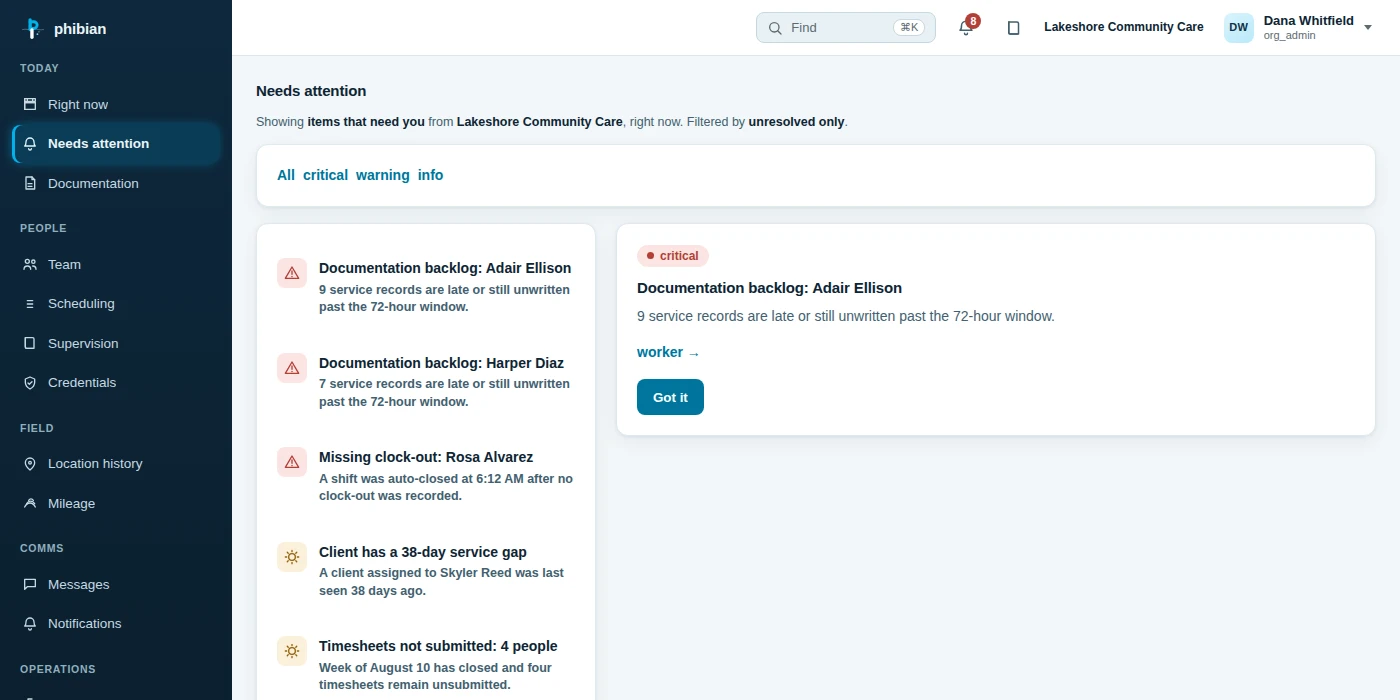
Admin optimises for visibility, coordination, approvals and analysis. Worker optimises for speed, clarity and trust in the field. Neither is a cut-down version of the other.
Admin — the operation, made legible.
A supervisor opens Phibian to answer three questions: is the work happening, is anyone falling through, and what needs me right now. The product is organised around those, not around a menu of reports.
Worker — the day, and the truth about it.
A worker opens Phibian to see today, record time where the work happens, and know that what the system holds about them is accurate, visible and correctable.
Go deeper
Explore a capability.
These pages explain the operational problem, how Phibian handles it, and how it shows up for both Admin and Worker.
Workforce & scheduling
People, programs, assignments, schedules, time off and the weekly approval cycle that closes the loop.
Explore workforceField & movement
Location-aware timekeeping, work-site geofences, authorized movement, and a field app that survives losing signal.
Explore fieldCompliance & evidence
Configurable rules, exceptions for human review, corrections that supersede, and an audit trail that holds up later.
Explore compliance